The consumer law traps hiding in ordinary small business marketing
Was/now pricing, gifted reviews, free offers and booking fees. The consumer law rules that catch Australian small businesses, and the penalties the ACCC issued.
Photo: Kgbo / Wikimedia Commons, CC BY-SA 4.0
In March 2026 an Australian photo-printing business paid $39,600 in penalties. It had not sold a faulty product. Nobody was hurt. Its offence was that on 107 occasions it told influencers not to mention that the products they were reviewing had been given to them for free, and on one occasion it edited a reviewer's video to cut out the bits where she called the software "a bit fiddly" and "a bit confusing".
That is the shape of most consumer law enforcement against small business in Australia. Not fraud. Ordinary marketing decisions that felt like tidying up.
The Australian Consumer Law applies to every business in the country regardless of size. There is no small-business exemption, no grace period and no threshold below which the rules stop applying. And in March 2026 the ceiling on corporate penalties doubled.
- The maximum corporate penalty doubled to $100 million on 28 March 2026
- Most small-business enforcement arrives as an infringement notice, currently up to $21,840 per notice
- Gifted products count as payment, and the disclosure obligation is the business's, not just the influencer's
- A "was" price you never genuinely sold at is a misleading representation
- New unfair trading practices law received Royal Assent on 6 July 2026 and commences 1 July 2027
The core rule is one sentence long
Section 18 of the ACL is the provision most enforcement ultimately rests on, and it is remarkably short.
"A person must not, in trade or commerce, engage in conduct that is misleading or deceptive or is likely to mislead or deceive."
Note what is missing. There is no requirement that anyone was actually misled, no requirement of intent, and no defence of honest mistake. The test is the overall impression created in the mind of the audience. You can be entirely sincere and still contravene it.
Section 29 then lists specific false or misleading representations, two of which deal directly with testimonials:
"make a false or misleading representation that purports to be a testimonial by any person relating to goods or services"
"make a false or misleading representation concerning: (i) a testimonial by any person; or (ii) a representation that purports to be such a testimonial; relating to goods or services"
The first catches inventing a review. The second catches misrepresenting a real one, which is where editing comes in.
Several other sections matter for everyday marketing. Section 32 deals with offering gifts, prizes or rebates you do not intend to provide as offered. Section 34 prohibits conduct liable to mislead the public about the nature or characteristics of services. Section 35 prohibits bait advertising, meaning advertising at a price you have no reasonable grounds to believe you can actually supply. Section 48 requires that where you quote a price, the total minimum price appears as a single figure, at least as prominently as any component of it.
Reviews and testimonials
The ACCC ran an internet sweep in 2023 and reported the results that December. Of 137 businesses reviewed, 37% displayed conduct the ACCC considered concerning.
The enforcement history here is long and the penalties are not trivial.
| Business | Penalty | Date | Conduct |
|---|---|---|---|
| HealthEngine Pty Ltd | $2,900,000 | Aug 2020 | Suppressed around 17,000 reviews and edited around 3,000; also shared 135,000 patients' data with insurance brokers without adequate disclosure |
| Electrodry franchisor (A Whistle & Co (1979) Pty Ltd) | $215,000 | Dec 2015 | Fabricated reviews on Google, True Local and Yelp for services never provided |
| Tomsem Consolidated Pty Ltd (PhotobookShop) | $39,600 | Mar 2026 | Instructed influencers not to disclose gifted products on 107 occasions; edited a review to remove criticism |
| Citymove Pty Ltd | $6,600 | Nov 2011 | Republished testimonials copied from an unrelated site with altered usernames and ratings |
The Citymove figure is the instructive one. Six thousand six hundred dollars, for a removalist, in 2011. You do not need to be big to be worth the ACCC's time when the conduct is clear-cut and cheap to prove.
Deleting a bad review is a moderation decision. Editing a good review to make it better is a representation about what a customer said.
The practical line is this. You may ask happy customers for reviews. You may not write them, buy them, or filter your public display so it no longer reflects the real distribution of feedback. And you may not edit a review's substance, because the review then misrepresents what the customer actually said.
Gifted products are payment
This is the rule small businesses most often do not know exists.
If you give someone free product in exchange for a post, that is a commercial arrangement and it must be disclosed. Not in a hashtag buried at the end of a caption, not in a link in bio, but clearly and prominently enough that the audience understands the post is commercial before they form a view of the product.
The ACCC's 2023 influencer sweep reviewed 118 influencers. It found 81% had posts raising concerns about inadequate disclosure. The worst sector was fashion at 96%. Gaming and technology sat at 73%.
PhotobookShop is the case that makes the exposure concrete, because the obligation ran against the business, not the influencers. The ACCC's position was blunt: businesses must not mislead consumers by failing to disclose when an influencer has been paid to create content, "whether that payment is free gifted products or services, or money".

If you send free product to creators, the compliance burden is yours. Put the disclosure requirement in writing in the arrangement, and check the post after it goes up.
Pricing: was, from, up to, and free
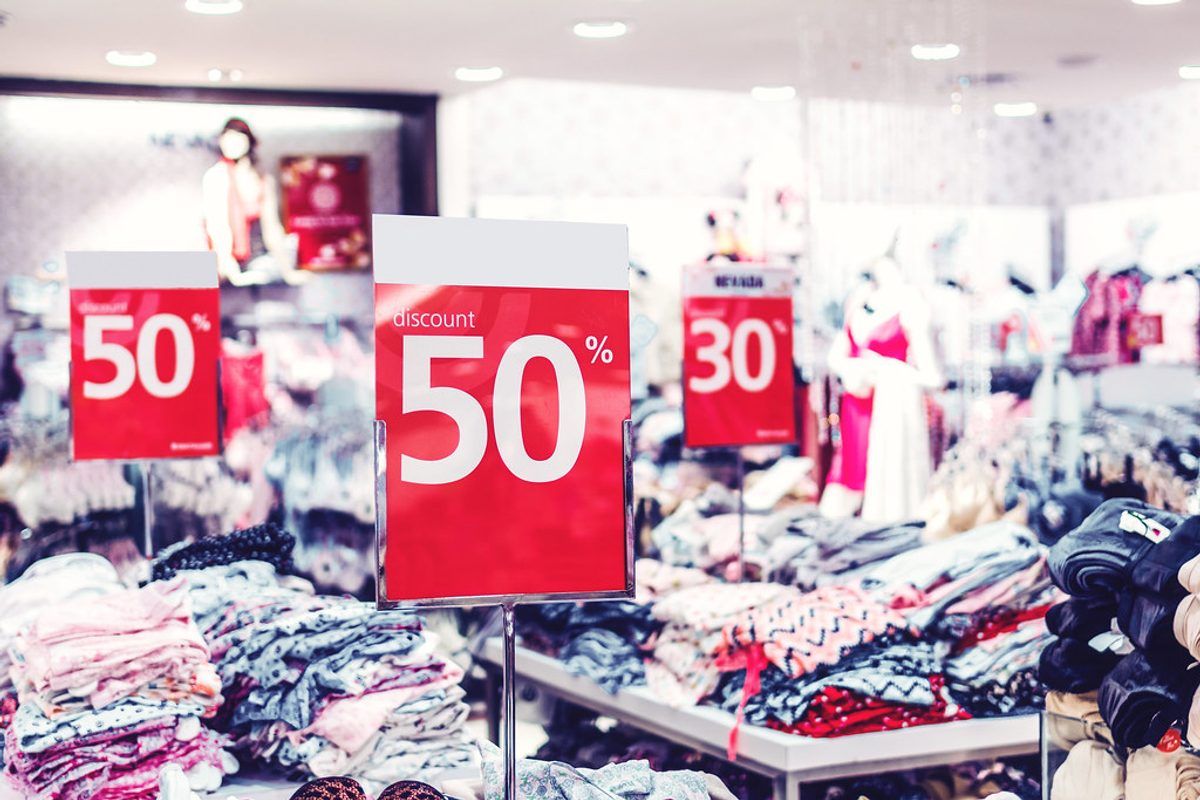
Was/now pricing. The strike-through price must be a price at which you genuinely offered the goods, for a reasonable period, recently enough that the comparison still means something. A price that existed for one week in order to justify a permanent "sale" is a misleading representation. There is no fixed statutory minimum duration; the test is facts and circumstances.
"From $X". Lawful only if you genuinely have stock or availability at that price, in reasonable quantities. Otherwise it is bait advertising under section 35.
"Up to X% off". The maximum discount must be genuinely available and applied to a meaningful part of the range, not one clearance item at the back of the store.
Drip pricing. This is the one that catches service businesses hardest. If a mandatory fee is added later in the booking flow, the headline price was never real. Jetstar paid $545,000 and Virgin Australia $200,000 in March 2017 for exactly this. In June 2025 Dendy Cinema paid $19,800 over a per-ticket booking fee that was not displayed prominently from the start of the online booking process.
Dendy is the case a small business should read. A single unavoidable booking fee, disclosed too late, settled by infringement notice.
"Free". Nothing described as free may carry a hidden cost or condition that effectively makes it not free. Bet365 paid $2.75 million in 2016 over a "$200 FREE BETS FOR NEW CUSTOMERS" promotion where customers had to deposit and wager $200 of their own money first, then turn the bonus over three more times before withdrawing anything.
Subscriptions. In July 2026 the Federal Court ordered JustAnswer to pay $10 million. Its chat widget offered access "for only AU$2 (fully refundable)" while in fact signing consumers up to an ongoing subscription costing between $45 and $75 per month.
- Every "was" price is a price you actually charged, for a real period, recently
- The first price a customer sees includes every unavoidable fee and GST
- "Free" means free, with no purchase, deposit or wager condition attached
- Any trial that converts to a paid subscription says so, at the point of signup, in the same visual weight as the offer
- A permanent sale where the "was" price is fictional
- Booking or service fees revealed at the final checkout step
What the penalties are now
On 28 March 2026 the Treasury Laws Amendment (Doubling Penalties for ACCC Enforcement) Act 2026 came into force. It is worth being precise about what it did, because the shorthand is being reported wrongly.
It doubled the maximum penalty for a body corporate from $50 million to $100 million. It did not change the individual maximum, which has been $2.5 million since the 2022 reforms.
The corporate maximum is not a flat number. It is expressed by the ACCC as the greater of:
"$100,000,000 if the Court can determine the value of the 'reasonably attributable' benefit obtained, 3 times that value, or if the Court cannot determine the value of the 'reasonably attributable' benefit, 30% of the corporation's adjusted turnover during the breach turnover period for the contravention."
For a small business, that 30% of turnover limb is the one to notice. It scales down as well as up, which is precisely why it exists.
The seven-figure penalties make the headlines, but they are not the number a small business should be planning around. In practice almost no small business meets a $100 million question. What it meets is an infringement notice. The Commonwealth penalty unit rose from $330 to $364 on 1 July 2026, which puts a single infringement notice at up to $21,840 for a body corporate and $4,368 for an individual. PhotobookShop's $39,600 was two notices.
What is coming
The Competition and Consumer Amendment (Unfair Trading Practices) Act 2026 received Royal Assent on 6 July 2026 and commences on 1 July 2027. It is law now; it simply is not in force yet. The twelve-month gap is the transition period, and it is the window in which to fix things quietly rather than expensively.
The ACCC also published its compliance and enforcement priorities for 2026/27 on 19 February 2026. Several land directly on small-business marketing conduct: misleading pricing practices in retail, misleading pricing and claims in essential services, greenwashing, unfair contract terms including automatic renewals and early termination fees, and manipulative practices in digital markets.
On environmental claims specifically, the ACCC's 2022/23 sweep found 57% of the 247 businesses it reviewed were making concerning claims, and it published an eight-principle guide for business in December 2023. "Eco", "green", "sustainable" and "carbon neutral" are all claims you must be able to substantiate.
Sources
- Australian Consumer Law, Competition and Consumer Act 2010 (Cth), Schedule 2
- Treasury Laws Amendment (Doubling Penalties for ACCC Enforcement) Act 2026, Act No. 19 of 2026
- ACCC, fines and penalties
- PhotobookShop pays penalties for influencer reviews, ACCC, 24 March 2026
- JustAnswer to pay $10m in penalties, ACCC, 8 July 2026
- HealthEngine to pay $2.9 million, ACCC, 20 August 2020
- Federal Court orders Electrodry franchisor to pay $215,000, ACCC, 18 December 2015
- Scrutiny of influencers and businesses for misleading advertising and online reviews continues, ACCC, 7 December 2023
- ACCC greenwashing internet sweep unearths widespread concerning claims, ACCC, 2 March 2023
- Jetstar and Virgin to pay penalties for misleading drip pricing practices, ACCC, 7 March 2017
- Dendy pays penalties for alleged drip pricing practices, ACCC, 25 June 2025
- ACCC compliance and enforcement priorities 2026-27, 19 February 2026
This is general information, not legal advice. The Australian Consumer Law applies differently depending on your industry, your customers and the conduct in question. SwayBlu is a content tool, not a legal advice service. If you are unsure whether specific marketing complies, get advice from a lawyer or contact the ACCC.
Marketing that holds up when someone checks.
SwayBlu writes your posts, plans and newsletters, then checks every line against the rules that bind your industry, before you publish.
Start free