AI compliance checks for finance marketing in Australia
ASIC's new RG 234 says AI-written finance ads face the same rules. What AI compliance checks catch, what they can't, and a pre-publish checklist.

On 28 July 2026 the Federal Court ordered Harvey Norman and Latitude Finance to pay a combined $55 million over a 60-month interest-free campaign. ASIC said the ads masked that customers had to take out a credit card and pay monthly fees. The Court found both companies' compliance processes "wholly inadequate to prevent the contravening conduct".
Seven weeks earlier, ASIC published the first rewrite of its advertising guide since 2012. The June 2026 edition of Regulatory Guide 234 says something the old one never had to: the rules apply in the same way to advertising written by AI.
That matters to every mortgage broker, lender, adviser and agency now drafting finance content with AI. A model can write a home loan post in seconds. Whether AI compliance checks can catch what is wrong with that post before it goes out is a different question, and it is the one this guide answers.
- RG 234 (June 2026) applies to AI-written ads exactly as it does to human ones, and warns that AI's hallucinated or biased content can raise the risk of misleading advertising
- A credit ad that quotes an interest rate must show a comparison rate, no less prominent than the rate, with the prescribed warning
- A false or misleading representation about financial services carries a civil maximum for a company of at least $18.2 million per contravention
- The guide reaches past the licensee to third-party promoters such as advisers, lead generators and agents, and to publishers including social media
- AI is good at the wording-level checks; it cannot confirm a rate is current or that you hold the evidence behind a claim
Can AI check financial marketing for compliance?
Yes for the wording. No for the facts behind the wording. Most of the confusion about AI and finance advertising comes from treating those as the same job.
There is no separate rulebook for AI-generated advertising in Australia. RG 234.5 says the guide applies to advertising in any medium "regardless of any specific technologies that may be used, including artificial intelligence (AI)". A note under that paragraph, repeated at RG 234.200, adds the practical warning: the law applies to AI content the same way it applies to human content, but the potential for hallucinated or biased content from AI tools may increase the risk of misleading or deceptive advertising.
So the question for a broker or an adviser is not whether AI is allowed. It is. The question is who checks what the AI wrote, and against what.
AI meets RG 234 in two places, and it is worth keeping them apart:
- AI writing your advertising. A post, an email, a reel script or a landing page drafted by a model. The promoter is responsible for it in exactly the way they would be if a junior copywriter had written it.
- AI as the thing you advertise. If you promote an AI-enabled advice tool or an AI feature inside your service, RG 234.153 says the ad should not overstate the tool's capabilities, and its risks and limitations should get the same prominence as its benefits. RG 234.17 extends the balance requirement to "any customer tools used as part of those services, including AI tools".
An AI compliance check for finance marketing is the first case turned around: software that reads a draft before it is published, flags the lines likely to breach a specific rule, names that rule, and suggests a safer wording. Done properly, it is a second reader that knows the rulebook. Done badly, it is a chatbot asked "is this compliant?", which will answer confidently either way.
The rules a finance compliance check has to know
Finance marketing in Australia is not one rulebook. Mortgage broker advertising rules, the rules for financial advisers and the rules for finfluencers overlap, but they are not the same. Which rules bite depends on what is being advertised, and a check that applies the wrong set will either miss real problems or bury you in irrelevant ones.
| If you advertise | The rules that matter most |
|---|---|
| Home loans, car loans, personal loans (brokers and lenders) | ASIC Act ss 12DA and 12DB; National Credit Code Part 10 (comparison rates) and s 154; credit licence under National Credit Act s 29; RG 234 |
| Financial advice, super, investments, insurance (advisers and licensees) | ASIC Act ss 12DA and 12DB; Corporations Act s 1041H; general advice warning under s 949A; licensing under s 911A; RG 234, RG 244 and INFO 269 |
| A financial product you are paid to talk about (finfluencers) | Whatever applies to the product itself, plus the unlicensed advice risk set out in INFO 269 |
Two points trip up general-purpose AI tools. The first is that credit and investments sit under different Acts. The ASIC Act's misleading conduct rules cover both, but the comparison rate rules belong to credit, and the general advice warning belongs to financial product advice. A home loan post does not need a general advice warning. A post recommending an ETF might.
The second is that the ASIC Act sets a strict standard. Under s 12GB, making a false or misleading representation about financial services is a criminal offence of strict liability, which means no intent is needed. RG 234.199 states the civil position the same way: the question is whether the ad is in fact misleading or likely to mislead, not whether anyone meant it to.
The comparison rate rule, and why AI drafts trip on it
This is the most mechanical rule in finance advertising and the one most likely to fall out of a fast draft.
Section 160 of the National Credit Code is one sentence long: a credit advertisement must contain the relevant comparison rate if it contains an annual percentage rate. Three more requirements travel with it:
- Name the example. The ad must clearly state the credit product, the amount of credit and the term the comparison rate applies to (s 162).
- Same weight. The comparison rate must be identified as a comparison rate and must not be less prominent than any annual percentage rate or repayment amount in the ad (s 164).
- The warning. The comparison rate must be accompanied by the warning prescribed by regulation (s 163), in either the long or short form set out in regulation 99. The short form reads:
WARNING: This comparison rate is true only for the examples given and may not include all fees and charges. Different terms, fees or other loan amounts might result in a different comparison rate.
ASIC gives concrete examples of a comparison rate that is less prominent than the rate at RG 234.58: smaller or faded type, a rate published online where the consumer has to click through or hover to see the comparison rate, or a comparison rate placed where it is easy to overlook or not close to the interest rate. Publishing a credit ad that does not comply is an offence under s 150 of the Code. Continuing credit contracts, such as most credit cards, and low cost credit contracts sit outside this Part (s 158).
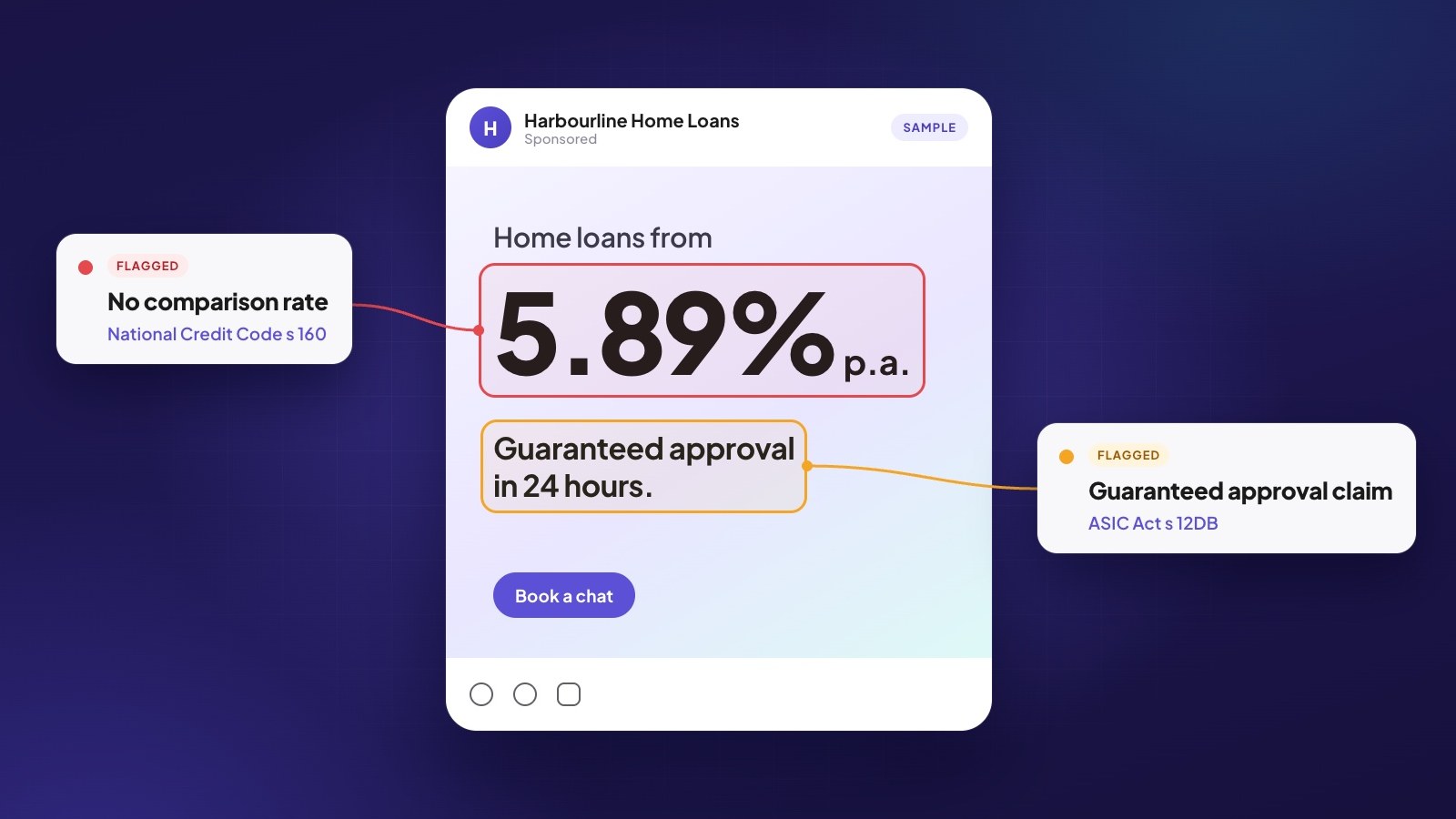
Here is why AI drafts trip on it. A model asked for a punchy Instagram post about a 5.89% rate is optimising for punchy, and a comparison rate, a loan amount, a term and a two-line warning are exactly the text a model trims for punch. The second failure is worse. Asked to "add the comparison rate", a model may simply produce one. A comparison rate is calculated from the lender's actual rate and fees for a stated amount and term. A model has neither, so any number it writes is invented, and an invented comparison rate is a misleading representation in its own right.
A good check flags the missing comparison rate, asks for the real figure from the lender, and adds the prescribed warning word for word. It never makes up a number.
- "Home loans from 5.89% p.a. Book a chat today."
- A 48-point headline rate with the comparison rate in grey 8-point type at the bottom of the tile
- "5.89% p.a.*" where the comparison rate only appears after a tap on "see details"
- "5.89% p.a. variable, comparison rate 6.04% p.a.* *Comparison rate based on a $150,000 owner-occupier loan over 25 years. WARNING: This comparison rate is true only for the examples given and may not include all fees and charges. Different terms, fees or other loan amounts might result in a different comparison rate."
What the June 2026 RG 234 asks of every finance ad
RG 234 is guidance, not law. It tells you how ASIC reads the laws above, which makes it the closest thing to a checklist the regulator publishes. The paragraphs that most often decide whether a post is fine:
- Balance (RG 234.16 to 234.18). Returns, features and benefits must be balanced against risks. Where an ad states or implies a benefit is likely, it should say something about the risks of getting it.
- Substantiation (RG 234.19). Claims about consumer outcomes must be able to be substantiated, and promoters should keep the records that do it. Under s 12GY of the ASIC Act, ASIC can issue a notice requiring that evidence within 21 days.
- Loaded words (RG 234.120). Take care with "free", "secure" and "guaranteed" where they are not used in their ordinary meaning. Outside finance, the same loaded-word traps catch ordinary small business advertising under the Australian Consumer Law.
- Restricted words (RG 234.124). "Independent", "impartial" and "unbiased" are restricted under Corporations Act s 923A where commissions or similar benefits are received.
- Testimonials (RG 234.130). They should be attributed to the person and authentic.
- Social media (RG 234.174 to 234.176). Consumers on a third-party platform are less likely to click through for the detail, so warnings and qualifications need to be drawn to their attention. The physical limits of a tile or a reel are not a reason to leave balance out (RG 234.175).
- Records (RG 234.177). Promoters should keep a record of their advertising.
- Finfluencers (RG 234.179). Influencers who discuss or promote financial products must make sure the content is not misleading and complies with the other financial services laws.
If an advertisement is misleading, then it cannot be cured.
The same paragraph sets out the test every check should be built around. Consumers cannot be expected to study an ad; the most important consideration is the overall impression on first viewing. A strong headline cannot always be fixed by a qualification underneath it, and silence about something a consumer would reasonably expect to be told can be misleading even when every stated fact is true.
Who is liable when a finance ad misleads
RG 234.3 says the guidance is relevant to promoters, and that the promoter can be a third party "such as a financial adviser, credit service provider, distributor, intermediary (e.g. lead generators), or agent", as well as to publishers including social media and digital platforms.
The ASIC Act goes further than the guide. Under s 12GBCL, a person who is involved in a contravention of a civil penalty provision is taken to have contravened the provision. INFO 269 makes the related point for influencers: you do not need to be licensed to breach the misleading or deceptive conduct provisions, and a licensee who uses an influencer may be liable for the influencer's misconduct.
The Harvey Norman case shows how this plays out. The retailer ran the campaign; Latitude provided the credit. Both were penalised, and the judge found them "equally responsible" for the contravening ads. For a marketing agency writing finance content for several clients, the safe working assumption is simple: if you made the ad, expect the ad to be read as partly yours.
What AI compliance checks can genuinely catch
Wording-level problems are where AI earns its keep, because they are pattern problems and a model can read every line of every draft without getting tired. A check built for Australian finance rules should catch:
- A rate with no comparison rate, and a comparison rate with no prescribed warning.
- Guarantee and no-risk language about returns or approval: "guaranteed approval", "risk-free returns", "you can't lose".
- Superlatives that need evidence: "Sydney's best broker", "the lowest rates in Australia", "fastest approvals".
- Unbalanced claims where a benefit is promised with no risk or condition in sight.
- A missing general advice warning on content that recommends or evaluates a financial product.
- Testimonials that look fabricated, edited or paid without disclosure.
- The same problems inside images. A headline rate on a tile is advertising too, and a check that only reads the caption misses half the post.
The useful output is not a score. It is the flagged line, the specific rule it may breach, and a rewrite you can accept or reject.
What AI cannot check
An honest check tells you where it stops. These are the parts a person still has to own:
- Whether a rate is real and current. A model can see that "5.89%" needs a comparison rate. It cannot know whether the lender is still offering 5.89% this week.
- Whether you hold the evidence. It can flag "rated #1 by our clients" as a claim that needs substantiation. It cannot see the survey that supports it, or whether there is one.
- Context outside the draft. Whether a post reads as personal advice can depend on the relationship with the person it is aimed at. Whether a landing page carries the conditions a post points to depends on the page.
- Licensing facts. It cannot confirm your licence or authorised representative number is correct or current.
- The final call. A check flags likely issues. It does not give legal advice and it does not certify anything. The business stays responsible for what goes out under its name.
A pre-publish RG 234 checklist for finance marketing
Run every post, email, reel script and landing page past these before it goes out, whether a person or a model wrote it.
- Does it quote an interest rate or a repayment amount? Then is the comparison rate there, labelled, at least as prominent, with the product, amount and term it applies to, and the reg 99 warning?
- Does it promise an outcome ("approved", "save", "earn", "pay off")? Is there a risk or condition next to it, and do you hold the evidence?
- Does it use "free", "guaranteed", "secure", "no risk", "best", "lowest" or "fastest"? Can you prove it today, in writing, within 21 days?
- Does it say "independent", "impartial" or "unbiased"? Check s 923A before you keep it.
- Does it recommend or rate a financial product? Does it carry a general advice warning, and is the person or business licensed to give that advice?
- Is there a testimonial? Is it attributed, genuine and unedited, and is any payment or gift disclosed?
- Read it as a stranger scrolling past. What is the overall impression on first viewing, and does the fine print change it?
- Is the image saying something the caption is not? Check the text on the tile, not just the copy under it.
- Is the AI-written part correct? Check every number, name and claim the model produced against a source.
- Keep a dated copy of what went out, the checks it passed, and the decisions you made.
How SwayBlu checks finance and credit content
We built SwayBlu's finance line around the distinctions above. A credit business is checked against the ASIC Act, the National Credit Code and RG 234. A financial services business is checked against the ASIC Act, the Corporations Act (including the general advice warning), RG 234, RG 244 and INFO 269. The two rule sets are kept apart on purpose.
- Post review reads the caption and the image together, flags each issue with the section it cites, and offers a rewrite of both.
- Document review does the same for PDFs and Word files, such as scripts, brochures and newsletters, and writes the changes you accept into a corrected copy. When a rate has no comparison rate, it asks you for the real figures instead of inventing one, and the warning it proposes is regulation 99's own wording.
- The website audit for credit businesses runs three fixed checks on your site: a rate with no comparison rate, a comparison rate with no prescribed warning, and guaranteed or risk-free return language.
- Content we create for regulated businesses, from single posts to a week's content plan, carousels and newsletters, is checked against the same rules after drafting and before it reaches you.
- Records keep every check, per client, dated, with the rule cited and the decisions made. They cannot be edited, and they export to Excel.
SwayBlu flags likely issues. It does not give legal advice or certify anything, and you stay the publisher of record. See how the finance checks work, or if you run content for several finance clients, how agencies use SwayBlu.
Frequently asked questions
Can mortgage brokers use AI to write marketing content?
Yes. No Australian law prohibits it, and RG 234.5 confirms the same rules apply to AI-written ads as to any other. The broker remains responsible for what is published, so every rate, claim and testimonial in an AI draft needs checking before it goes out, with particular care for comparison rates.
Does ASIC regulate AI-generated financial advertising?
ASIC regulates the advertising, not the tool. RG 234 (June 2026) applies regardless of the technology used, including AI, and notes that hallucinated or biased AI content can increase the risk of misleading ads. Ads for AI-enabled advice tools must not overstate what the tool can do (RG 234.153).
Is it illegal to advertise a home loan rate without a comparison rate?
Generally, yes. Under s 160 of the National Credit Code, a credit ad that contains an annual percentage rate must contain the comparison rate, with the prescribed warning, and no less prominently. Most credit cards and low cost credit contracts are carved out by s 158.
What is the comparison rate warning?
It is the statement prescribed by regulation 99 of the National Consumer Credit Protection Regulations, in a long or short form. The short form begins "WARNING: This comparison rate is true only for the examples given". It must accompany any comparison rate in a credit ad.
Can a marketing agency be liable for a client's misleading finance ad?
It can. Under s 12GBCL of the ASIC Act, a person involved in a contravention of a civil penalty provision is taken to have contravened it, and RG 234 applies to third-party promoters such as agents and intermediaries. Agencies writing finance content should check it as if it carried their name.
Are finfluencers regulated by ASIC?
Yes. RG 234.179 says finfluencers must make sure promotional content is not misleading and complies with the financial services laws. Under INFO 269, recommending products without an AFS licence or authorisation can be unlicensed advice, and a licensee who pays an influencer may be liable for the influencer's misconduct.
Does "this is not financial advice" protect a post?
Not on its own. A disclaimer does not change what the content does. If a post recommends a product, it may still be financial product advice, and RG 234.199 is clear that a misleading ad cannot be cured by accurate information somewhere else.
Sources
- ASIC Regulatory Guide 234, Advertising financial products and services (including credit), June 2026
- Australian Securities and Investments Commission Act 2001 (Cth), ss 12DA, 12DB, 12GB, 12GBA, 12GBCA, 12GBCL, 12GY
- National Consumer Credit Protection Act 2009 (Cth), Schedule 1, National Credit Code, ss 150, 154, 158, 160 to 164
- National Consumer Credit Protection Regulations 2010, reg 99
- ASIC Information Sheet 269, Discussing financial products and services online
- ASIC Regulatory Guide 244, Giving information, general advice and scaled advice
- Harvey Norman and Latitude ordered to pay combined $55 million penalties for misleading customers, ASIC 26-171MR, 28 July 2026
- Crimes (Amount of a Penalty Unit) Instrument 2026, penalty unit of $364 from 1 July 2026
This is general information, not legal advice. The rules apply differently depending on your licence, your products and the content in question. SwayBlu is a content and review tool, not a legal advice service. If you are unsure whether specific marketing meets the law, get advice from a lawyer or your licensee's compliance team.
Every rate and every return, read before it goes out.
SwayBlu checks posts, documents and website pages for finance and credit businesses against the ASIC Act, the National Credit Code and RG 234, and names the rule behind every flag.
See the finance checks